

CSA Z94.3 vs ANSI Z87.1: What Canadian Workers Actually Need to Know
ANSI or CSA? What the two safety eyewear standards mean, how they differ, and what Canadian workers and employers actually need to check before buying.
You pick up a pair of safety glasses. The arm says "Z87." Another pair says "Z94.3." A third says both. Most people on a Canadian jobsite have worn all three without ever knowing what the difference is; until a site safety officer, an inspector, or an employer's PPE policy suddenly makes it matter.
Here's the short version, then the details.
The short version: ANSI Z87.1 is the American standard for safety eyewear. CSA Z94.3 is the Canadian one. They test for the same basic things, impact resistance, optical quality, and coverage, but they're administered differently, marked differently, and they're not automatically interchangeable.
In Canada, workplace eye protection requirements come from your provincial occupational health and safety regulations, and most reference CSA Z94.3. Many workplaces accept dual-certified eyewear, and some accept ANSI-rated eyewear for lower-risk work, but that call belongs to your employer's hazard assessment, not the sticker on the box.
What ANSI Z87.1 is
ANSI Z87.1 is published by the American National Standards Institute and it's the benchmark for eye and face protection in the United States. OSHA, the American workplace safety regulator, requires eyewear that meets it.
The standard covers impact resistance, lens quality, UV and radiation filtering, and coverage. You'll see two impact markings in the wild:
• Z87 — basic impact rating
• Z87+ — high-impact rating, tested with a steel ball fired at the lens at high velocity and a heavier dropped projectile
Because a huge share of safety eyewear sold in Canada is made by or for the U.S. market, ANSI markings are everywhere on Canadian shelves and especially on Amazon. That's not a flaw, it just means you need to know what your workplace requires.
What CSA Z94.3 is
CSA Z94.3 is the Canadian standard, published by the CSA Group. It covers eye and face protectors for occupational and educational use and is the standard referenced by most provincial OHS regulations and by safety regulators like WorkSafeBC in British Columbia and the CNESST in Quebec.
Functionally, it tests for the same core hazards as ANSI: impact, optical clarity, radiation, coverage. But there are real differences in how the two systems work.
THE DIFFERENCES THAT ACTUALLY MATTER
1. Who does the certifying. This is the biggest one, and almost nobody talks about it. Under ANSI Z87.1, manufacturers generally self-certify, they test (or contract testing) and declare compliance. Under CSA Z94.3, certification is third-party: testing and evaluation is done by CSA Group or by a lab that CSA qualifies and audits. A CSA mark on the frame means an independent body verified the claim.
2. Why so few suppliers are actually CSA certified. Here's the part the standards documents don't tell you: CSA certification is expensive and demanding, so a lot of legitimate manufacturers skip it. It's not just testing the glasses, CSA certification also requires inspection and certification of the facility where they're made, with ongoing audits. When we inquired with CSA about certifying Sunneys eyewear, the range quoted for going through the full process fell in the neighborhood of $20,000–$30,000/ year. That cost is exactly why many producers opt out. Instead, they'll have a third-party lab verify the eyewear complies with CSA Z94.3 without carrying full CSA certification, which leaves the choice, and the cost, with the buyer. This is the real reason you see "meets CSA" far more often than "CSA certified." It usually isn't a quality gap. It's a cost-and-process gap.
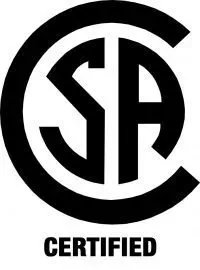
3. "Meets CSA" is not "CSA certified." Watch for this phrase when you shop. A product that says it meets CSA Z94.3 is telling you the manufacturer ran its own tests and believes it would pass. A product that is certified to CSA Z94.3 carries the CSA monogram and went through CSA's independent process. Those are very different claims wearing similar words. If your workplace requires CSA compliance, ask which one you're looking at.
4. Markings. ANSI-rated lenses are stamped Z87 or Z87+. CSA-certified eyewear carries the certification mark on the components, lenses, frame front, temples, and any removable parts. If the marking isn't physically on the eyewear, the rating effectively isn't there either, no matter what the packaging said.
5. Scope details. The standards diverge in some specifics; for example, ANSI Z87.1 includes testing designations for dust and splash exposure that CSA Z94.3 handles differently, and the standards take different approaches to side protection requirements. For most general impact-hazard work the practical protection is similar; for specialized hazards (chemical splash, radiation, high-velocity grinding), the details matter and your hazard assessment should drive the spec.
So what's actually required in Canada?
This is where people expect a clean answer and the honest answer is: it depends on your province and your employer.
Workplace safety in Canada is provincially regulated. Most provincial OHS regulations require eye protection appropriate to the hazard and reference CSA Z94.3 as the benchmark. Employers are responsible for conducting hazard assessments and specifying PPE that complies with their site or province's rules. Some workplaces and regulators accept ANSI-rated equipment, particularly where hazards are lower-risk or where eyewear is dual-certified; others require the CSA mark, full stop.
Three practical takeaways:
1. If you're a worker: check your employer's PPE policy before buying your own eyewear. If the policy says CSA, look for the CSA mark on the frame; not just the box.
2. If you're an employer: your hazard assessment drives the requirement, and your provincial OHS regulation is the authority. When in doubt, dual-certified eyewear settles the question before it's asked.
3. If you're buying for both work and everything else: dual-certified or ANSI Z87.1-rated eyewear with clear markings gives you protection you can verify. Just confirm it matches what your site requires.
How to check the glasses you already own
Take them off and look at them. Seriously — this takes ten seconds.
• Check the inside of the temples (arms) and the lens edges for Z87 or Z87+ (ANSI) or the CSA monogram with Z94.3 (CSA)
• On CSA-certified eyewear, marks should appear on the lens, frame, and temples — including removable side shields if it has them
• No markings anywhere? Then whatever the packaging claimed, you can't prove the rating — and neither can a site inspector
Where Sunneys Fits

We build safety eyewear that's certified and marked, because an unverifiable rating protects nobody, and we publish exactly what each product is rated for on our certifications page. Our Rangers, Classics, and Blitz Creek lines are ANSI Z87.1 or Z87+ certified with the markings to prove it, with anti-fog, and designed so you don't take them off the second you leave the site.
Work hard. Look sharp. Stay safe — and check the temple arms.
FAQ
Can I wear ANSI Z87.1 glasses on a Canadian jobsite?
It depends on your your employer's PPE policy and provincial regulations. Many sites accept ANSI-rated or dual-certified eyewear; some require the CSA mark. Ask before you buy.
Is CSA Z94.3 "stronger" than ANSI Z87.1?
Not in a simple way. Both test impact resistance rigorously. The bigger difference is process: CSA certification is third-party verified, while ANSI compliance is generally manufacturer-declared. Specific test requirements also differ in scope.
At Sunneys we have all of our safety glasses third-party verified for Z87 certification.
What does Z87+ mean?
It's ANSI's high-impact rating — the eyewear passed high-velocity and high-mass impact tests beyond the basic Z87 requirement.
What's the difference between "meets CSA Z94.3" and "CSA certified"?
"Meets" is the manufacturer's own claim. "Certified" means CSA Group (or a CSA-audited lab) independently tested and verified it, and the eyewear carries the CSA mark.
Do prescription safety glasses follow the same standards?
Yes — CSA Z94.3 covers prescription protective eyewear in Canada, and ANSI Z87.1 covers it in the U.S. Prescription safety eyewear needs the same markings as non-prescription.
Popular posts
Excepteur sint occaecat cupidatat non proident
By Mark Smith on Jan 5, 2022
By Mark Smith on Jan 5, 2022
By John Doe on Jan 5, 2022
Adipisci velit, sed quia non numquam eius
By John Doe on Jan 5, 2022
By Mark Smith on Jan 5, 2022
About this blog
Donec sollicitudin molestie malesuada. Nulla quis lorem ut libero malesuada feugiat. Pellentesque in ipsum id orci porta dapibus. Vestibulum ante ipsum primis in faucibus orci luctus et ultrices posuere cubilia Curae; Donec velit neque, auctor sit amet aliquam vel, ullamcorper sit amet ligula. Quisque velit nisi, pretium ut lacinia in, elementum id enim. Donec sollicitudin molestie malesuada.


Created with ©systeme.io